the marketThe traffic arrives
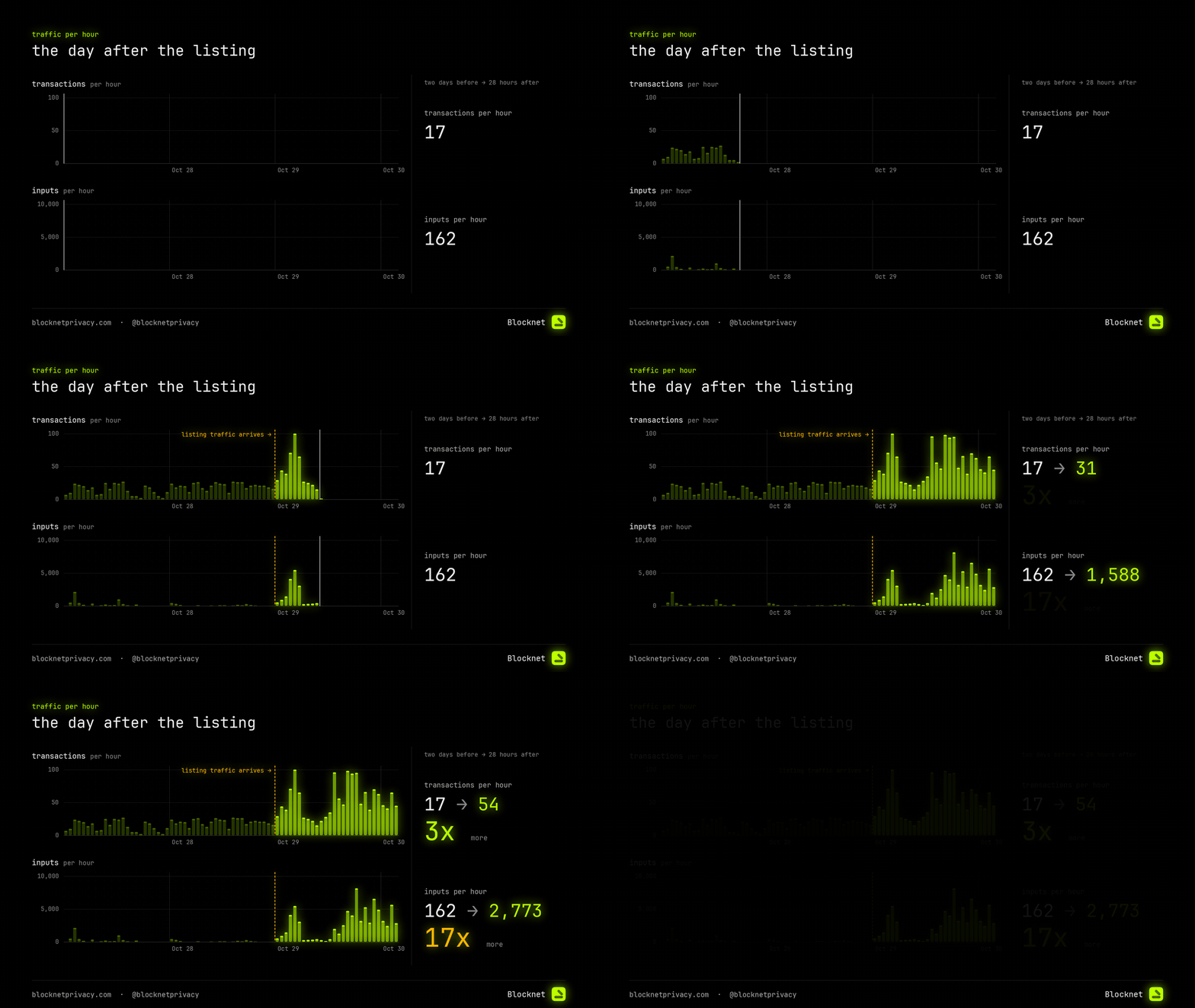
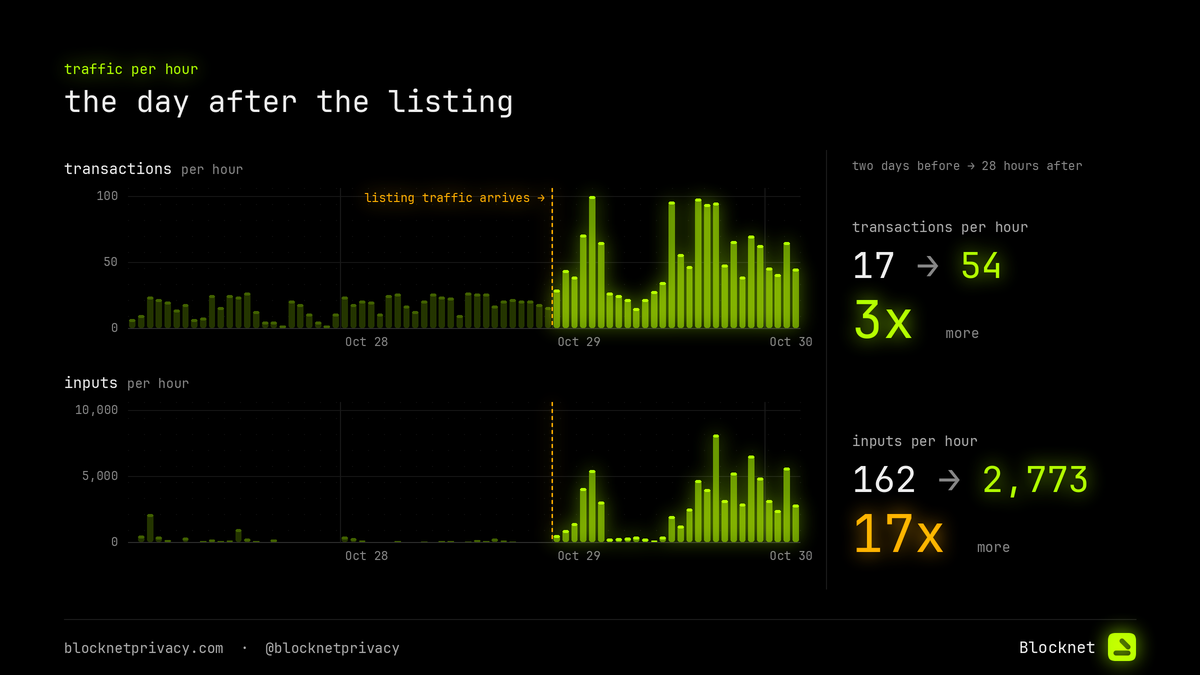
For two days before the listing the chain carried about 17 transactions an hour. Blocks had room to spare. In those two days, exactly one block filled up.
Then the evening of October 28 (US time) hit, and the chart changes shape. Transactions per hour tripled. The number of coins being spent, the inputs, went up 17 times. People were sweeping piles of small payouts into single coins to move them to the exchange.
block spaceThe first full block

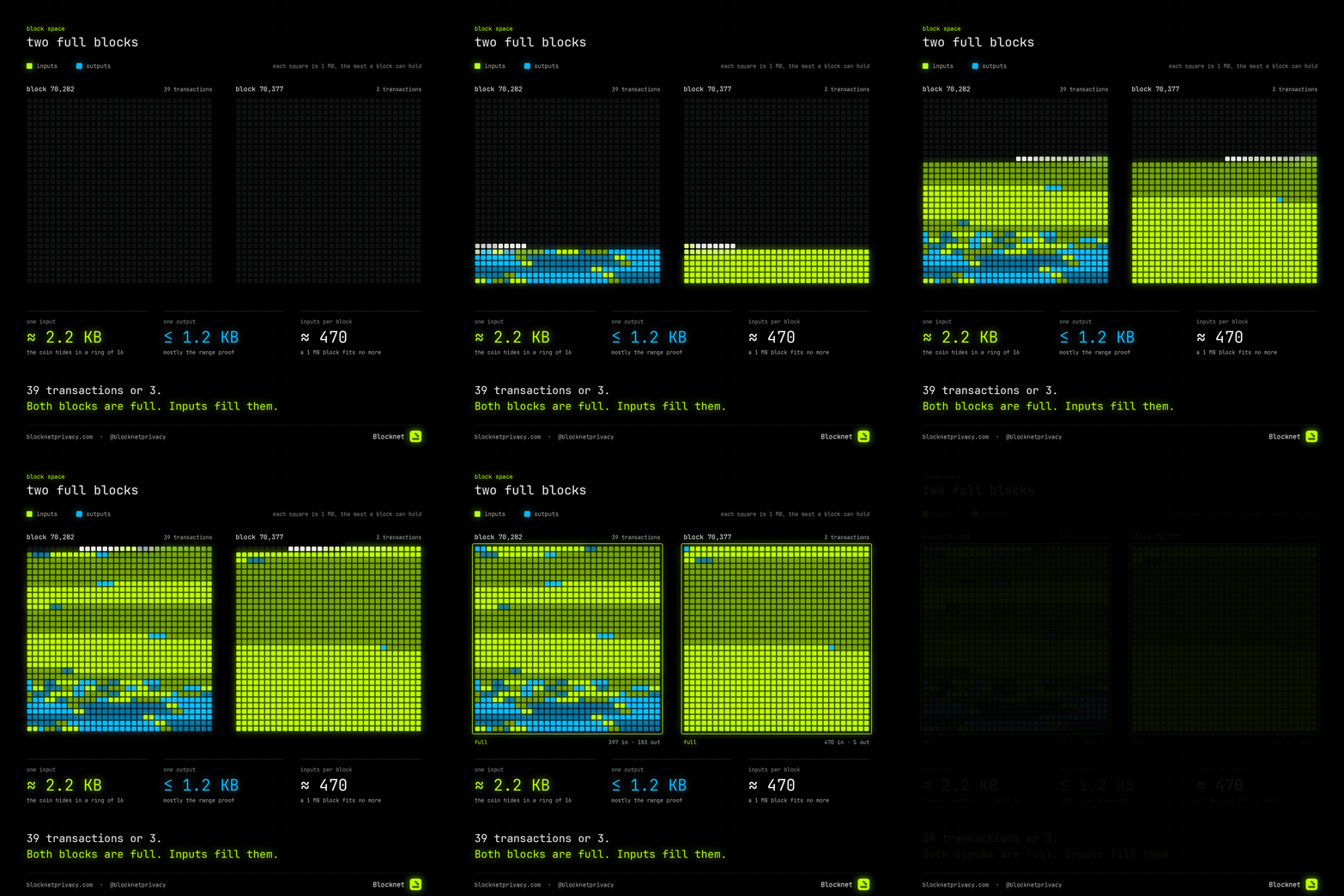
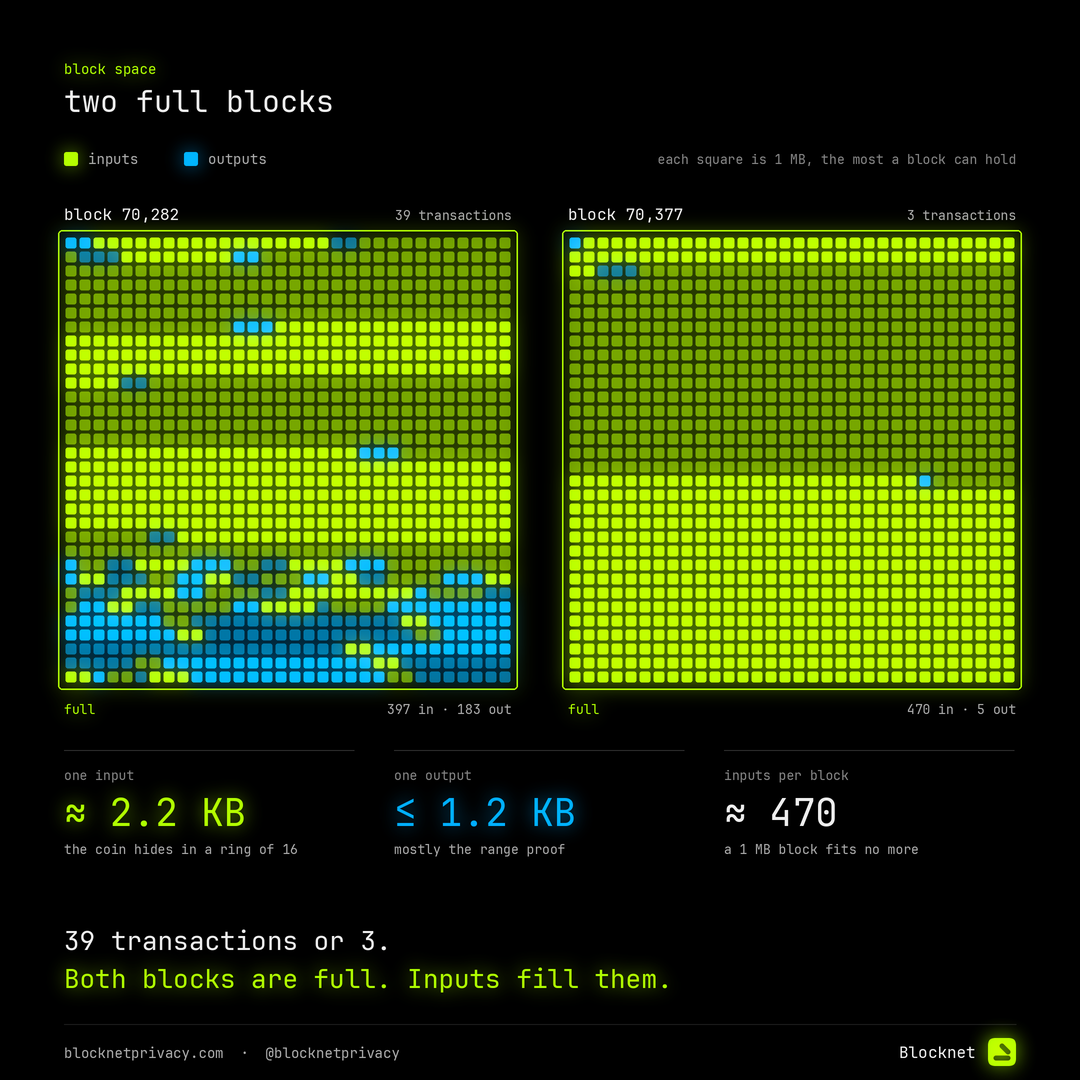
Block 70,142 was the first block the rush filled to the top. Before Faraday, a block holds at most 1 MB (1,048,576 bytes). That's a consensus rule. Every node checks it, and changing it takes a hard fork.
A block fills up by bytes, and the bytes come from inputs and outputs.
Each input is about 2.2 KB. Every coin you spend hides in a ring of 16: the real one plus 15 decoys. The input carries all 16 keys, all 16 amount commitments and one signature over the whole ring. That's the price of privacy, paid per coin.
Each output is up to about 1.2 KB. Most of that is a range proof, which shows the hidden amount is a real, positive number without showing the amount.
So a 1 MB block fits about 470 inputs. A couple of wallets sweeping a few hundred coins each fill a block on their own. Flip the panel to block 70,377: three transactions, two of them sweeps of more than 200 coins. Next to it, block 70,282 fits 39 ordinary sends in the same space.
That's why the line moved slowly even when blocks came on time. A block full of sweeps clears three transactions. A block of plain sends clears forty.
the mempoolAlmost 200 in line
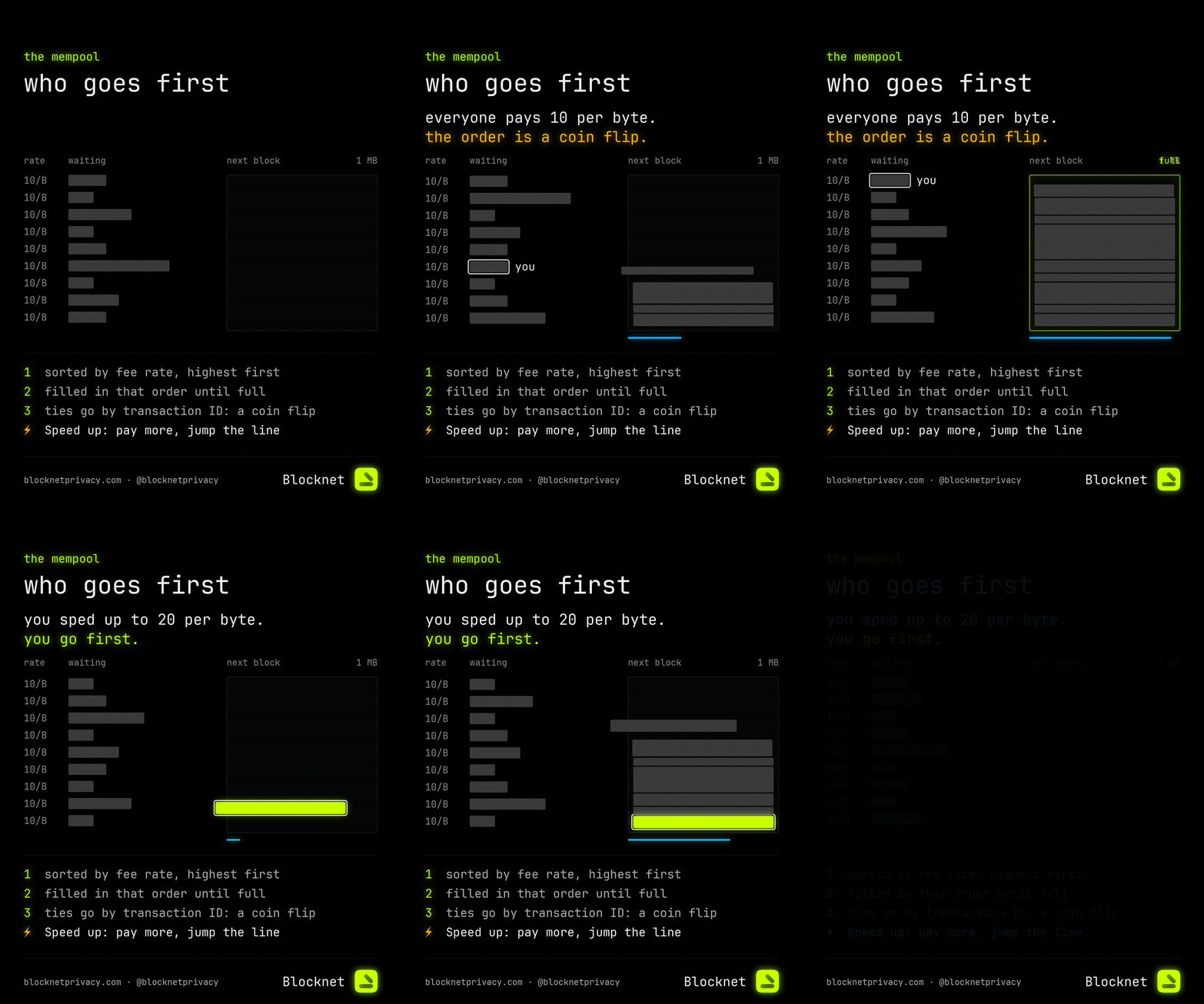
At the worst point almost 200 transactions waited in the mempool. Some waited for hours. To see why, look at how a block gets built.
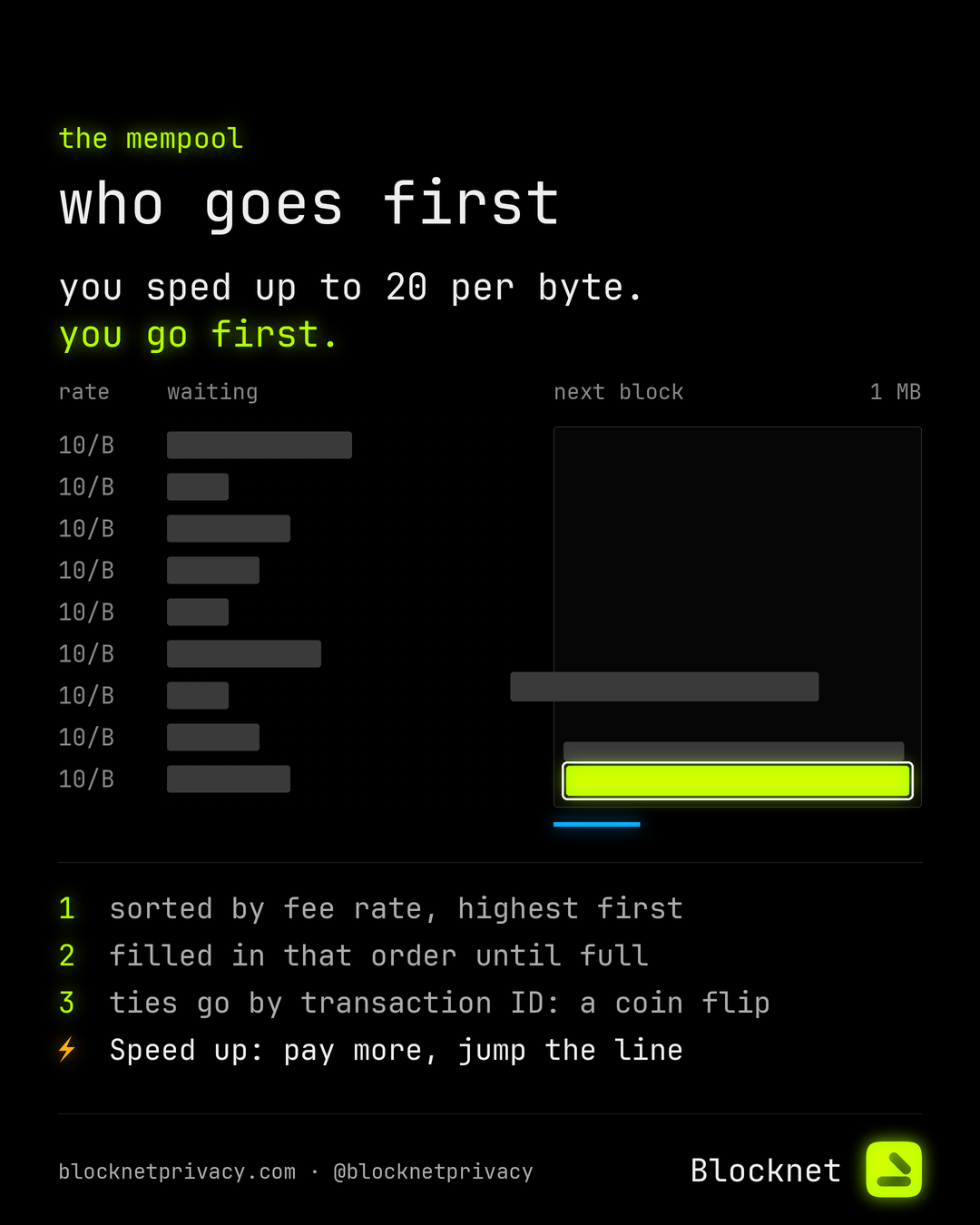
When a miner starts on a new block, their node builds a block template, the list of transactions that go in it. Pools get their template from a node the same way. The node sorts every waiting transaction by fee rate, highest first, then adds them in that order until the block is full. When one doesn't fit in the space left, it skips it and tries the next, so small sends fill the gaps.
Your place in line is your fee per byte. A big sweep that pays a big fee at the base rate sits level with a small send at the base rate.
In four days the chain saw 2,540 transactions. Every one of them paid the base rate, because no wallet could pay anything else.
When everyone pays the same rate, the node breaks the tie by transaction ID. That's a random-looking string of letters and numbers, so in practice your place in line was a coin flip. A send from an hour ago could wait while a send from a minute ago went first.
Where do those fees go today? They're burned, on purpose. The block reward is fixed, and every fee leaves the supply for good. Each send makes the total amount of BNT a little smaller, so busy days push back against inflation. Senders paid 18.05 BNT in fees in those 28 hours, and all of it came out of the global supply.
From Faraday on, that changes. The miner who mines a block gets the block reward plus every fee inside it. The node already sorts by fee rate, so a higher fee gets you in sooner today. After Faraday, miners also get paid for taking you first.
the minersDifficulty peaks at 88.3M
A listing brings in traders. It also brings in miners. As the price and the attention went up, so did the hashrate. Difficulty went from a low of 21.7 million on the morning of October 28 to 88.3 million at block 70,280, four times higher, in about a day.
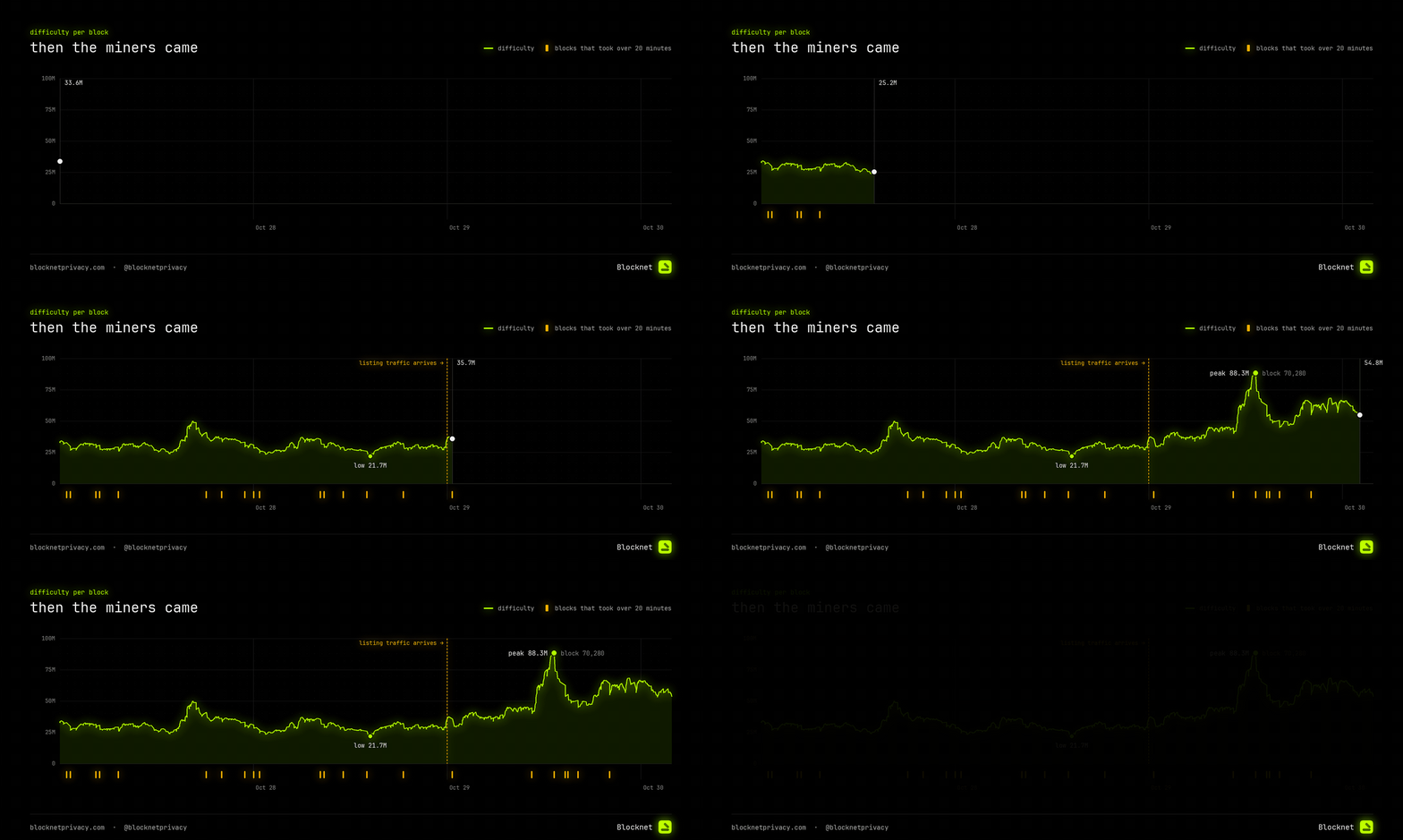
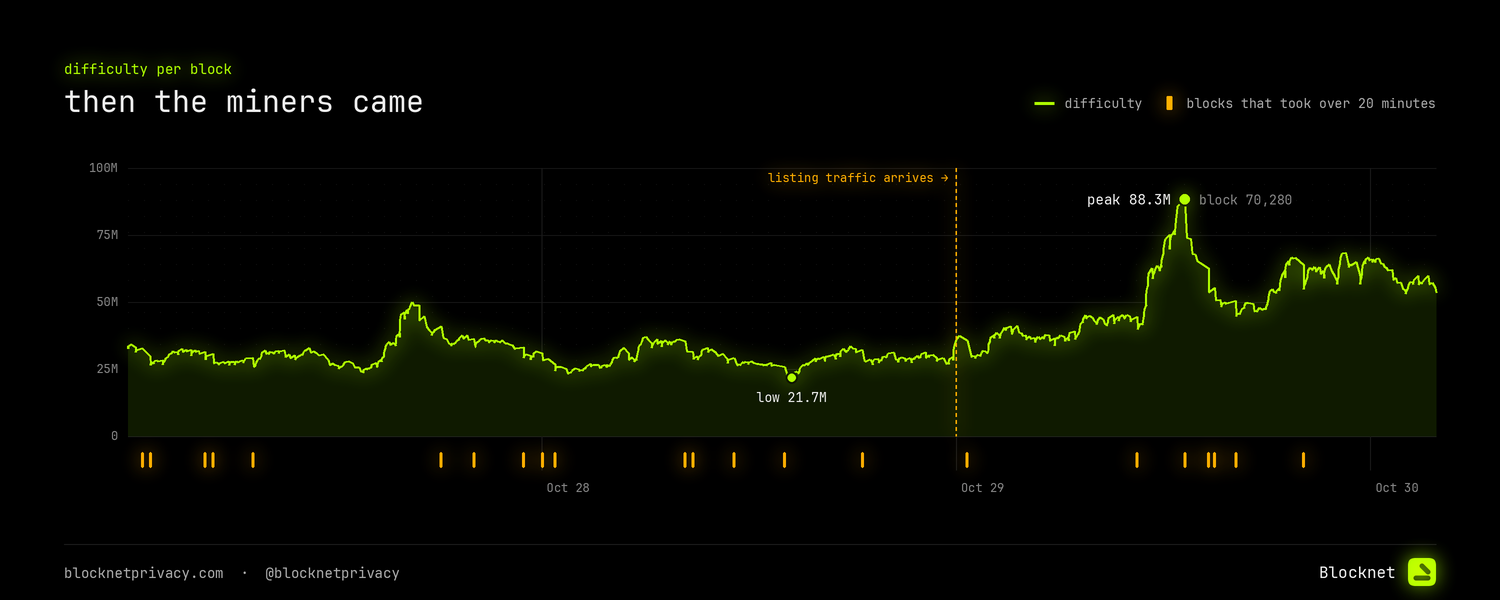
The chain retargets difficulty every block, using the last 60 blocks, about 5 hours. That keeps blocks near 5 minutes apart on average, and it worked: the average gap in those 28 hours was 296 seconds. When new hashrate arrives faster than the retarget can follow, blocks come quick. 56 blocks in those 28 hours came in under a minute.
the hangover10 blocks in 2 hours
Then some of that hashrate moved on. The miners who stayed now faced a difficulty set for a crowd. Right after the peak, the chain made 10 blocks in 2 hours, where 24 is normal. Later that afternoon block 70,297 took 36 minutes.
Retargeting works on averages, and an average needs time. With a 60-block window, a big swing in hashrate takes hours to wash out. Until it does, blocks come in bursts and gaps.
Slow blocks on a full mempool make the line longer. Fast blocks clear it. This is where a fee you choose matters most. When blocks are slow and full, the fee decides whether you're at the front or the back.
newPick your own fee
Starting with Core v0.24.0 you choose how fast you want to go. The wallet asks the node for the base rate and adds your choice on top.
Normal pays the base rate, 10 per byte. Fast adds 10, for 20 per byte. Urgent adds 40, for 50 per byte. Custom takes any whole number on top of the base.
Play with the calculator. A plain send, one coin in with a payment and change out, costs 0.00047 BNT at Normal and 0.00094 BNT at Fast. In a rush like this one, Fast puts you ahead of everyone at the base rate, which was the entire line.
In the Blocknet app for desktop and Android, the send screen has a fee slider under the amount. It spells out the fee and the total before you send. Urgent and Custom ask you to tick a box first. If you type a fee 100 times the base or more, the app tells you it's a lot and asks again. It won't stop you. It's your money. You can set a default level in Settings.
blocknet.id $yourname Your address, but short.Free for 9+ characters. claim yours→
In the blocknet program, send asks for a priority, and the priority command sets your default.
Sending to a $name? Your wallet saves the address the name pointed to when you sent. If you speed that send up later, it pays the same address, even if the name has moved since.
new⚡ Speed up a stuck send
- same payment, same address✓
- same coins, may add one✓
- same rings of 16✓
- rate at least +10 per byte✓
- can confirm twicenever
Picking a fee helps before you send. Speed up helps after. If a send is stuck, you pay more and move it up the line.
Every send that's still pending has a ⚡ Speed up button in the app: on the Dashboard, in History and in the transaction details. Tap it, pick a faster level, and the app shows what the new fee costs on top of the old one. In the blocknet program it's bump <txid>. You can try the button in the animation at the top of this page.
How it works. Your wallet builds the same payment again, to the same address, with a higher fee. The node takes the new version and drops the old one from its mempool. Both versions spend the same coins, so the chain can only ever accept one of them. Paying twice is impossible.
Privacy. Every coin hides in a ring of 16. If the new version picked new decoys, someone could compare the two rings, and the real coin would be the one in both. So the new version reuses the exact same rings, and comparing them shows nothing new.
GET THE APP Speed up is one tap. Blocknet for desktop and Android. Pick a fee, see the total, and speed up anything stuck. download→Your recipient sees a single pending payment. The payment output is identical in both versions. Only your change shrinks, by the extra fee.
While the network upgrades, some nodes still run older versions. They keep the old version of your send, and a miner on one of them can still mine it at the old fee. That's fine. Your payment goes through once, at one fee or the other.
Restarts. Before v0.24.0, if your node restarted while a send was waiting, it forgot the send. Now Core saves your own pending sends and puts them back after a restart, so you can still speed them up.
On the command line? Get the blocknet program.
nextFees go to the miner
The fork rule for this ships in Core v0.24.0 and switches on at block 103,680, the Faraday height. From that block on, the miner's reward is the block reward plus every fee in the block, to the atom. Before it, a block that claims fees is rejected. After it, a block that leaves them out is rejected.
Why the change. Burning fees makes sense today. Blocks are cheap to build, and every fee shrinks the supply. Faraday changes the work. Spends get bigger, so fees go up a bit. Miners also take on real extra work for every block: they check each spend's proof and fold all of them into one proof for the whole block. Fees that pay for that work belong to the people doing it.
Pools don't need any change of their own. They pay miners from the block reward the node reports, and from Faraday on that number includes the fees. Every pool does need to run Core v0.24.0 or newer before block 103,680, or it splits off the chain at the fork.
to the miners and traders
A job well done.
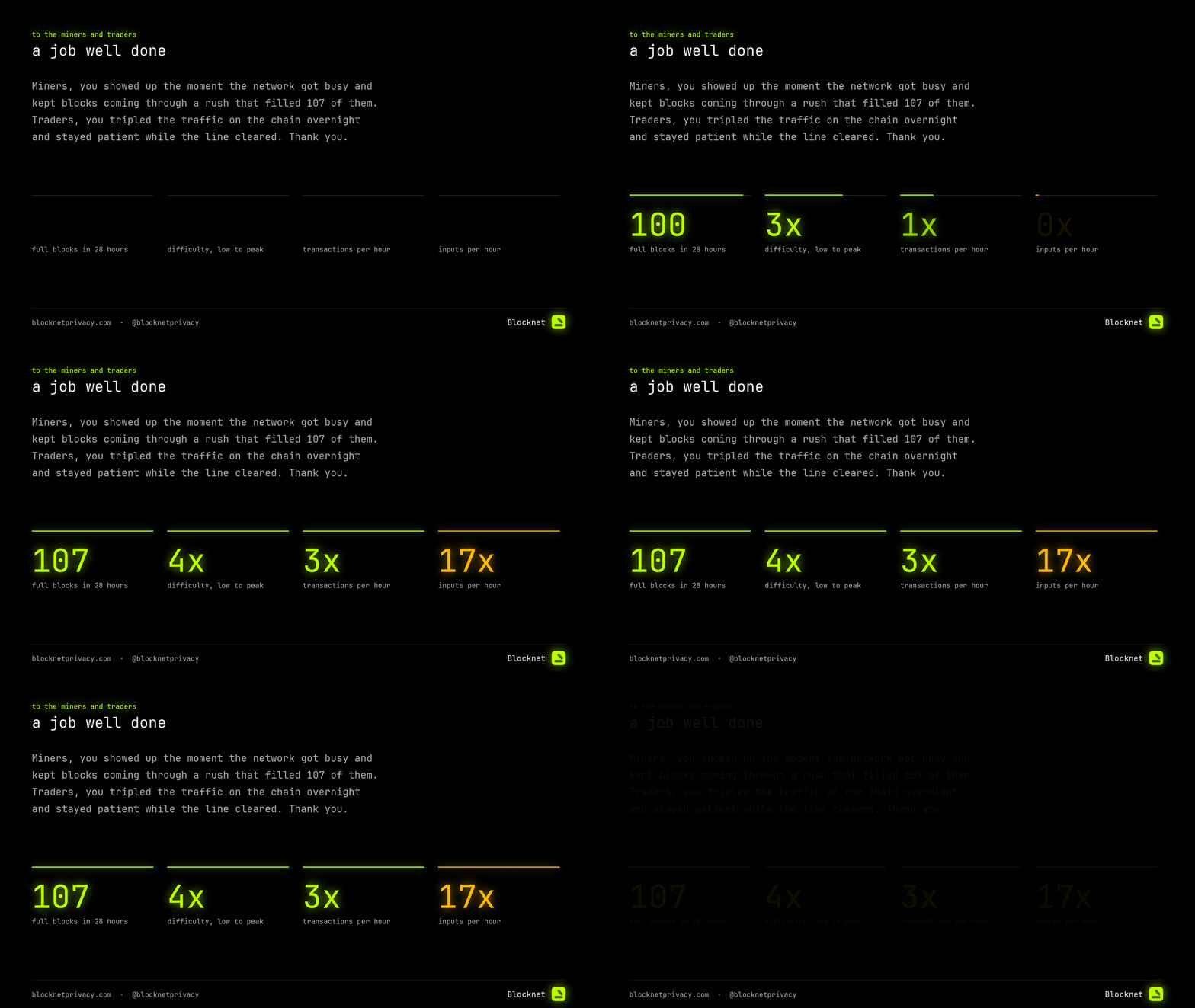
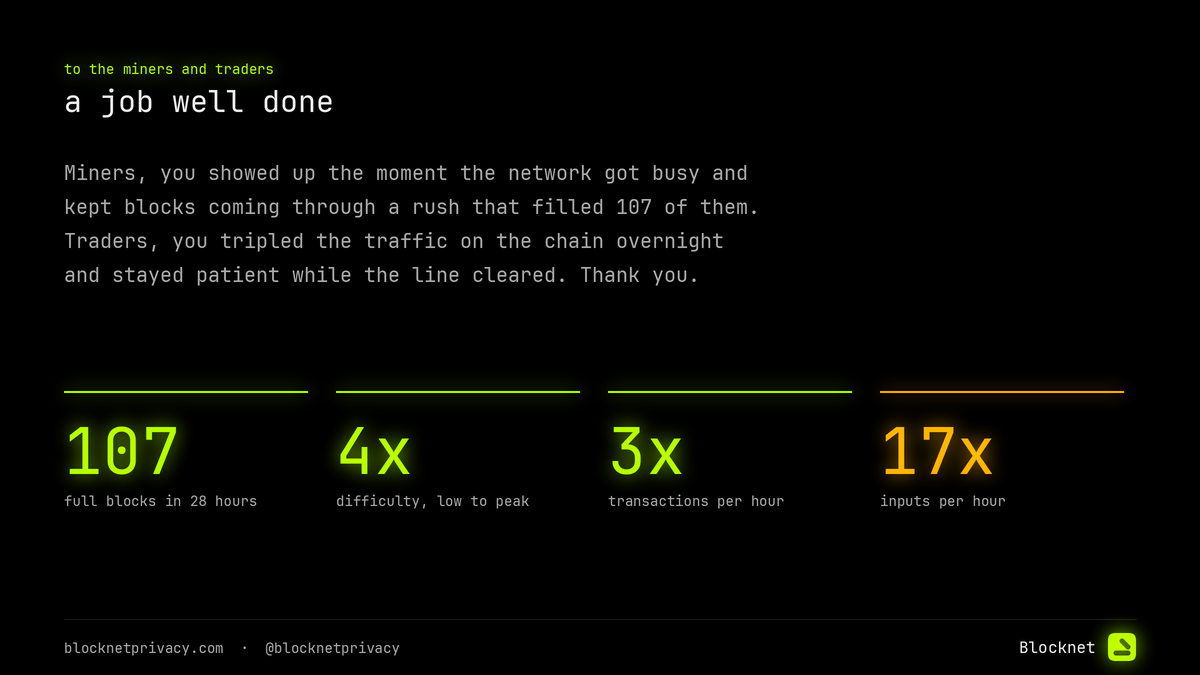
Miners, you showed up the moment the network got busy and kept blocks coming through a rush that filled 107 of them. Traders, you tripled the traffic on the chain overnight and stayed patient while the line cleared.
Thank you, all of you. This is what a live network looks like, and we're building the tools to make the next rush a lot smoother.