01 · whyWhy we're doing this
In June, Justin Drake from the Ethereum Foundation posted a long thread about quantum computing (here). He's a co-author on a Google Quantum AI paper that made the quantum attack on Bitcoin and Ethereum signatures about 10x cheaper. A startup published a paper the same day saying that kind of attack could run on as few as 10,000 physical qubits, far fewer than anyone expected.
He also pointed at ecdsa.fail, an open challenge where anybody, AI agents included, can submit a cheaper version of the attack's main building block. By their own count in their paper, the best entry costs less than half of Google's version.
Then he put dates on it.
Today, before Faraday, Blocknet protects coins with the same family of math as Bitcoin, Ethereum and Monero (elliptic curves). If that breaks, someone could spend coins that aren't theirs. On a privacy coin it's worse, because nobody would see it happen. After the Faraday upgrade, that math is gone from everything that protects your coins.
That thread is what started Faraday. We named it after the Faraday cage, the metal box that blocks signals you can't see. Faraday does the same job for your coins: it protects them from a threat you can't see coming.
02 · whatWhat changes
Faraday replaces every piece of curve math that protects your coins. The chain, its history and your balance stay. Nobody starts over.
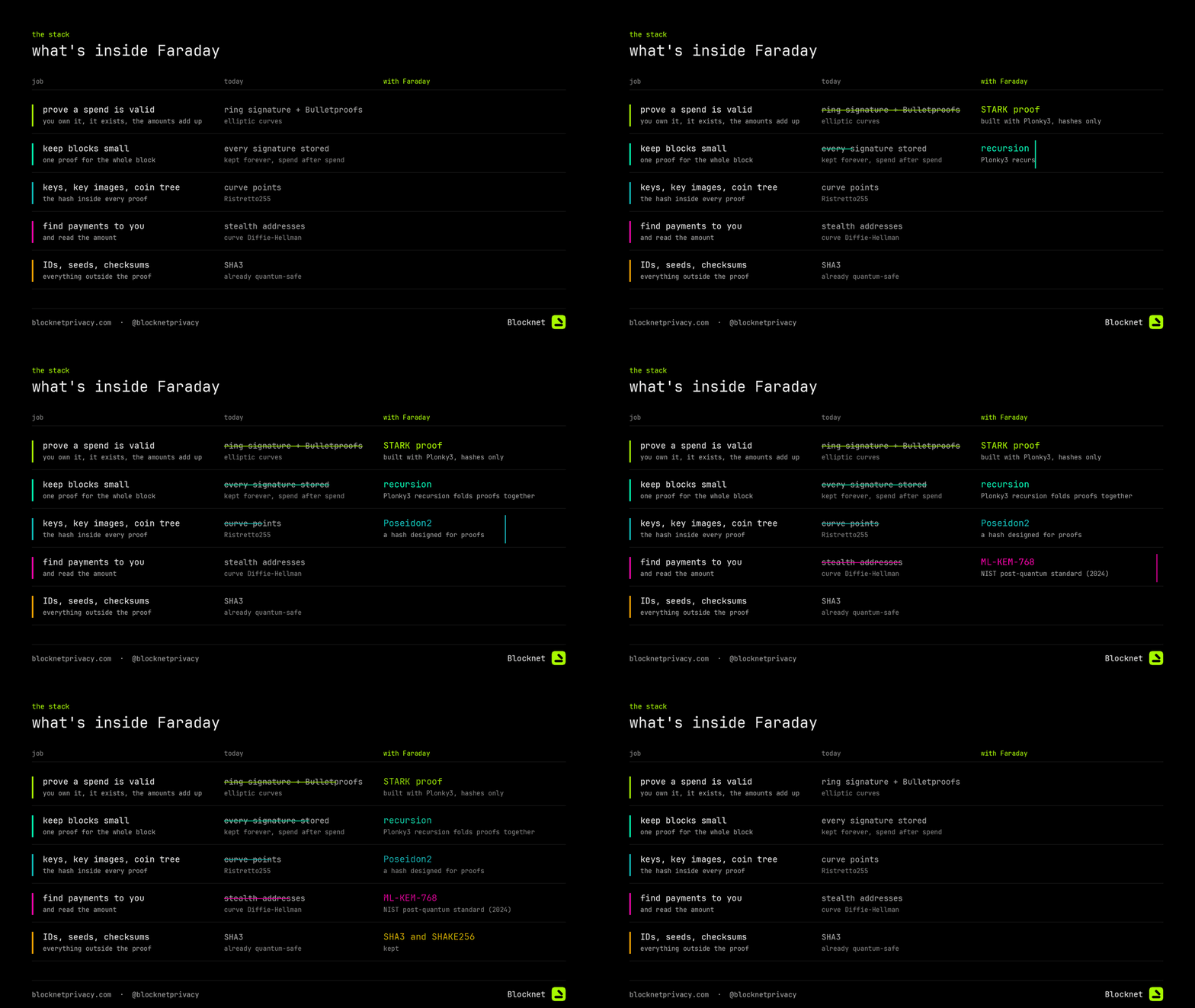
- Spending. Every spend carries one proof built from hash functions. Hashes are the part of crypto that quantum computers are worst at breaking.
- Receiving. Wallets find their payments with ML-KEM, the post-quantum standard NIST published in 2024.
- Privacy. Today a spend hides in a group of 16 coins, itself plus 15 decoys. That's the same setup Monero uses right now. With Faraday a spend proves it came from somewhere in the whole set of Faraday coins, so every one of them is a possible sender.
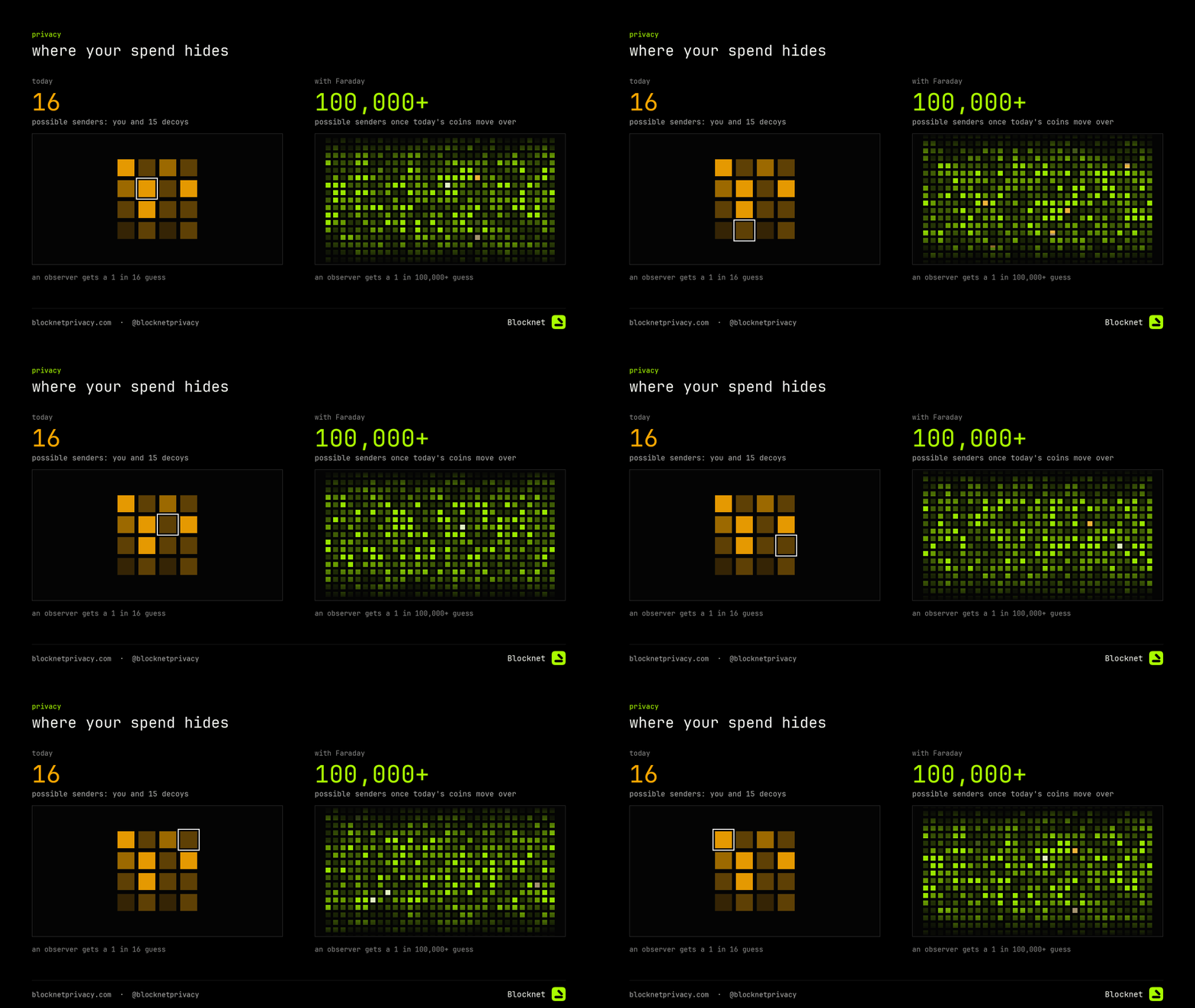
Faraday gets full-chain privacy and quantum safety from the same proof. Every Faraday coin is part of the crowd your spend hides in, and the crowd grows with every block.
03 · youWhat it means for you
Your coins. After the fork you get one year to move your coins over. We'll publish the exact steps before the upgrade. Moved coins wait about a week before you can spend them again.
blocknet.id $yourname Your address, but short.Free for 9+ characters. claim yours→
Coins that aren't moved within that year are lost.
Your recovery words. Your 12 words keep working. New wallets get 24 words. If your wallet was imported from keys and never had recovery words, you'll make a new wallet and move your coins into it.
Your address. Post-quantum addresses are a lot longer, about 1,700 characters. You'll copy and paste them or scan a QR code. Nobody is typing one by hand, and with a blocknet.id name nobody has to see it either. People pay $yourname and that's it.
Sending. Your wallet builds the proof for each spend itself. That takes a few seconds on a normal computer.
Fees. Spends are bigger, so fees go up. The numbers aren't set in stone yet, but we're working hard to keep fees on normal transactions as low as possible.
Running a node or mining. Your node updates itself for the fork. Mining changes at the fork too, and that gets its own post.
04 · sizeThe trade-off is size
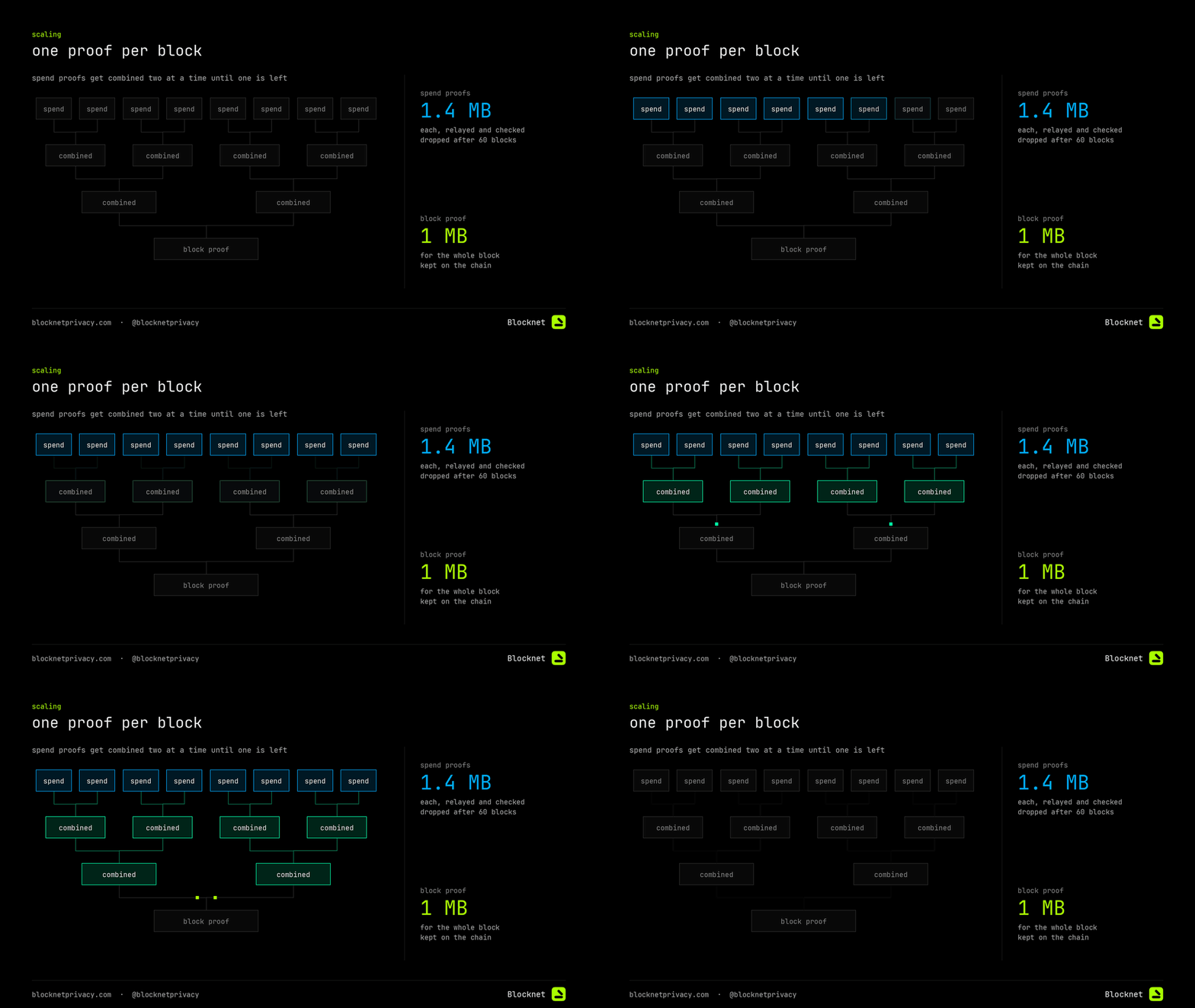
A spend today carries about 1-2 KB of signature. A Faraday spend proof is about 1.4 MB.
That proof doesn't stay on the chain. Nodes pass it around, check it, and drop it once the block is final. Each block keeps one combined proof for all of its spends, about 1 MB however many spends it holds. That's how the chain stays a sane size.
Saving a few hundred KB wasn't worth the risk to anyone's funds. A Faraday proof works by running random spot checks on the spend. Each check is one more chance to catch a fake. We could make proofs smaller by running fewer checks, but that makes a fake easier to slip through. So we kept enough checks to clear NIST's first level of quantum security (as hard to break as AES-128), with room to spare by our math. We keep checking that math ourselves, all the way to launch.
05 · timeBlock time and finality
Block time. Blocks go from every 5 minutes to every 10. Each spend carries a 1.4 MB proof, and the network needs the extra time to pass those proofs around and combine them into one per block.
Reward. The block reward doubles at the same moment. At the fork month that's about 343 BNT per block going to about 685. Half as many blocks at twice the reward is the same 98,700 or so new coins per day, so the emission schedule doesn't move.
Finality. Today a node accepts a reorg up to 100 blocks deep, about 8 hours. After Faraday the limit is 60 blocks, about 10 hours. Anything older is final and can't be swapped out. Newly mined coins wait those same 60 blocks before they can be spent, so a reorg can never take back mined coins that someone already spent.
Confirmations. Wallets still wait 10 confirmations before calling a payment safe. At 10-minute blocks that's about 100 minutes, up from about 50.
Sync. Syncing a new node gets faster. Today checking one block's mining work takes about 1.1 seconds on our test machine. After Faraday that check takes microseconds.
06 · proofHow we're checking our work
We spend every hour of the day trying to break Faraday, so nobody else gets there first. These checks have already assisted in finding and fixing upstream code.
we try to break it, nonstop
Fuzzers run around the clock, throwing broken, random and hand-mangled proofs at the verifier. Every one of them has to be rejected. On top of that we plant bugs in the verifier on purpose, thousands of them, and make sure our tests catch every one. A test that can't catch a planted bug gets fixed.
two versions have to agree
Every rule is written twice: once as plain reference code and once as the real proof circuit. We feed both the same spends, good and bad, and they have to give the same answer. In our last full run that was 20,000 cases with zero disagreements.
the benchmark
We published sigbench. It runs the real Blocknet signature code and the real Faraday proof code side by side and measures time, CPU and memory. You can run it yourself and check us. Some of it isn't pretty yet: combining proofs for a block takes minutes on a test machine, and we're working on it.
fixes go upstream
Faraday is built on Plonky3. While testing we found two bugs in its recursion library (the part that combines proofs) that could let a bad proof pass. We reported both privately, worked with the Plonky3 team on the fixes, and they credited us on both. The details stay private until the fixes are public. Without their work our job would be a lot harder, so we'll keep sending them what we find.
07 · whenWhen
We're aiming for the one-year anniversary of Blocknet's mainnet launch in February 2027, at block 103,680. Your node and wallet will tell you when the upgrade is coming and update themselves for the fork. The exact date depends on testing, like everything else in this post.